
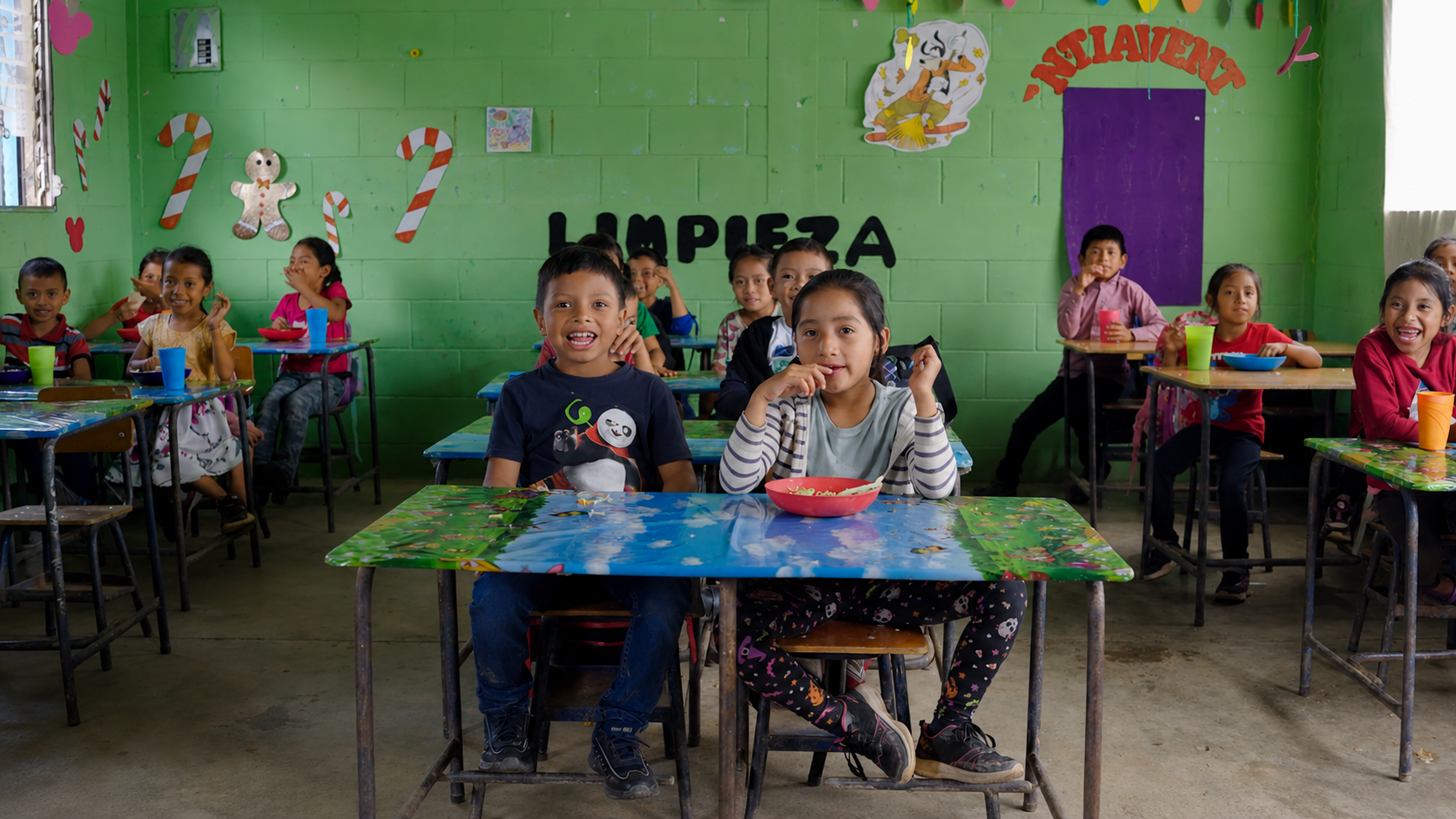
In Sweden, school meals are widely recognized as an essential public investment in children’s health, learning, and wellbeing. Yet in many parts of the world, school feeding remains far more than an educational support system—it can be a lifeline.
In the Dry Corridor of eastern Guatemala, where recurring droughts, poverty, food insecurity, and climate shocks affect thousands of rural families, school meals have become a powerful entry point for addressing multiple development challenges at once. They are helping children learn, strengthening local food systems, supporting caregivers, and creating safer environments for vulnerable children.
For We Effect, this experience offers an important lesson: when school feeding is connected to local production, community participation, and child protection, it can become a driver of sustainable rural development.
When Hunger Reaches the Classroom
Guatemala has one of the highest rates of chronic child malnutrition in Latin America. The situation is particularly severe in rural and indigenous communities across the Dry Corridor, where prolonged droughts, crop losses, limited economic opportunities, and restricted access to water undermine household food security.
The consequences extend far beyond nutrition.
Teachers and families consistently report that children who arrive at school hungry struggle to concentrate, participate, and remain engaged in learning. Food insecurity often contributes to poor educational outcomes and increases the vulnerability of children to other risks, including child labour and school dropout.
Recognizing these interconnected challenges, We Effect and Seeds for Progress Foundation, with support from Radiohjälpen, launched MAYA NUTRI, a two-year initiative in the municipalities of Camotán and Esquipulas.
Rather than focusing solely on food distribution, the initiative sought to demonstrate how school feeding can become a platform for strengthening local food production, community organization, child protection, and educational outcomes.
Building a Community Around Children’s Wellbeing
Over two years, MAYA NUTRI delivered more than 305,000 meals through schools, childcare centres, and community kitchens, reaching approximately 7,023 children.
However, the project’s most significant achievement may be the way it mobilized entire communities around children’s wellbeing.
School gardens enabled children to learn how food is produced while developing practical knowledge about nutrition and healthy diets. Families established household gardens that contributed both to food consumption and local income generation. At the community level, 215 women organized collective cooking initiatives, sharing knowledge, recipes, and mutual support.
For We Effect, this reflects a broader understanding of school feeding: not simply as a service, but as a community-centred approach that strengthens local capacities and promotes long-term resilience.
“The potential of school feeding goes far beyond providing meals,” says Mauricio Solís, Programme Manager at We Effect Central America. “It can connect schools, families, women producers, and local food systems around a common goal: ensuring children grow, learn, and thrive.”
The initiative also established 55 school, family, and community gardens, while 12 community kitchens provided nutrition support and care services for approximately 320 children under five years old.
Schools as Spaces of Protection
In eastern Guatemala’s coffee-growing regions, seasonal migration during harvest periods creates another often overlooked challenge.
Many families travel temporarily to coffee plantations in search of work, and children are frequently left without adequate supervision or exposed to situations that increase their vulnerability.
To address this issue, MAYA NUTRI implemented childcare and protection centres under a methodology known as Cultivating Education. These centres provided meals, educational activities, and safe environments for children during coffee harvest seasons.
A total of 271 children participated in these protection spaces, helping families balance economic needs with children’s wellbeing and development.
This experience highlights an often underappreciated dimension of school feeding systems: their potential contribution to child protection and care.
Strengthening Local Food Systems
One of the most innovative aspects of the initiative was its effort to link school meals with local food production.
In 11 rural schools, meal programmes were complemented with locally grown vegetables and protein-rich fortified foods. Mothers involved in meal preparation participated in training on food hygiene, nutrition, and food safety while developing new recipes to improve meal quality.
Students also took active roles in managing school gardens and participating in student leadership groups, strengthening skills such as teamwork, responsibility, and civic participation.
Additional activities included deworming campaigns reaching more than 2,100 students, nutrition education sessions, and the installation of water purification systems to improve access to safe drinking water.
Together, these interventions demonstrate how school feeding can support healthier food environments while creating economic opportunities for local producers and communities.
Women at the Centre of Community Care
While initially designed to improve child nutrition, community kitchens evolved into something much larger.
They became spaces where women could organize, build leadership, exchange knowledge, and strengthen community networks.
More than 200 women actively participated in these processes. Many went on to lead collective gardens and productive activities, while men and young people increasingly engaged in conversations about shared responsibility for caregiving.
This community-based approach reflects We Effect’s conviction that sustainable development is built through collective action and local ownership.
A Model with Global Relevance
As countries around the world seek solutions to food insecurity, learning loss, climate vulnerability, and social inequality, the experience of MAYA NUTRI offers valuable insights.
School feeding programmes are often discussed primarily as nutrition interventions. The experience in Guatemala suggests they can achieve much more.
When connected to local agriculture, community participation, childcare, and education, school feeding programmes can simultaneously improve nutrition, support learning, strengthen local economies, reduce vulnerability, and build resilience.
For We Effect, this is not simply a project outcome. It is evidence that school feeding can serve as a strategic investment in sustainable development.
As global discussions increasingly focus on the future of school meals and food systems, experiences from communities such as Camotán and Esquipulas demonstrate that effective school feeding is not only about what is served on a plate.
It is about creating the conditions for children, families, and communities to thrive.