
Agricultural Investment: A Foundation for Security, Stability and Growth
Date
June 3, 2026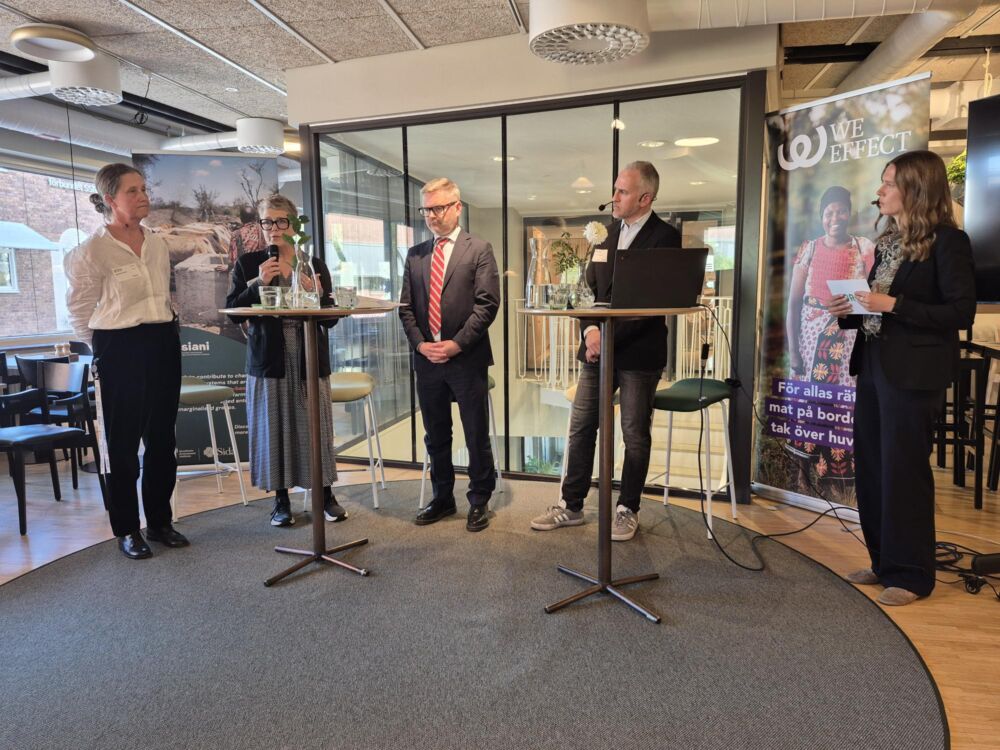
From left to right: Moderator Christina Furustam (LRF – Federation of Swedish Farmers), Anna Tibblin (We Effect), Daniel Liljeberg (Swedish FAO Committee), Love Theodossiadis (Sida) and Clara Fröman (Fores).
The event brought together experts from the development and agricultural sectors to explore how investments in sustainable agriculture contribute to both global stability and Swedish economic and security interests. It was opened by Love Theodossiadis, economist and development analyst at Sida.
In his presentation, Theodossiadis highlighted the significant decline in development assistance in recent years. Support to the least developed countries, particularly in sub-Saharan Africa, has fallen sharply. A similar trend can be seen in Swedish development cooperation, where support to several of the world’s poorest countries and regions has been phased out.
At the same time, global progress against poverty and hunger is stalling. Climate-related shocks, conflict, geopolitical instability, and weak economic growth are expected to push even more people into poverty and food insecurity.
Anna Tibblin, Secretary General of We Effect, illustrated how global crises directly affect vulnerable communities. She highlighted how the recent conflict involving Iran and disruptions to shipping through the Strait of Hormuz have increased the cost of fuel, agricultural inputs, and food worldwide. For the Maasai Kajiado Women Dairy Cooperative in Kenya, supported by We Effect, rising transport costs mean that members struggle to bring their milk to market, threatening a vital source of income. Tibblin also referred to FAO projections indicating that the recent crises in the Middle East could push an additional 45 million people into food insecurity.
Against this backdrop, Tibblin and Theodossiadis argued that investments in agriculture are urgently needed and should be viewed as cost-effective investments in stability, economic growth, and security.
Panellists Daniel Liljeberg, State Secretary for Rural Development and Chair of the Swedish FAO Committee, and Christina Furustam, International Expert at the Federation of Swedish Farmers, agreed that food security, peace, and economic stability are closely interconnected. Both emphasised the essential role farmers play in building resilient societies.
Moderator Clara Fröman from Fores invited the panellists to reflect on the most important forms of support for small-scale farmers. Furustam and Tibblin stressed that farmers should be recognised as entrepreneurs and agents of change rather than passive beneficiaries. They highlighted the importance of profitability, market access, and long-term solutions to ensure agriculture remains an attractive and viable sector. Theodossiadis pointed to the potential for development cooperation to expand support for financial services such as loans and insurance tailored to agricultural producers.
The discussion concluded with a clear message for decision-makers. While recent global crises have increased awareness of the links between food systems and security, as reflected in Sweden’s Food Strategy and the Reform Agenda for Development, greater efforts are needed to translate policy ambitions into concrete action.
As Anna Tibblin noted in her opening remarks, the question is no longer whether we can afford to invest in sustainable agriculture, but whether we can afford not to.
Jonna Wiklund
Stockholm Environment Institute