
We Effect Highlights the Role of Cooperatives in the Care Economy and Green Transition at the ICA-Americas Forum
Date
December 4, 2025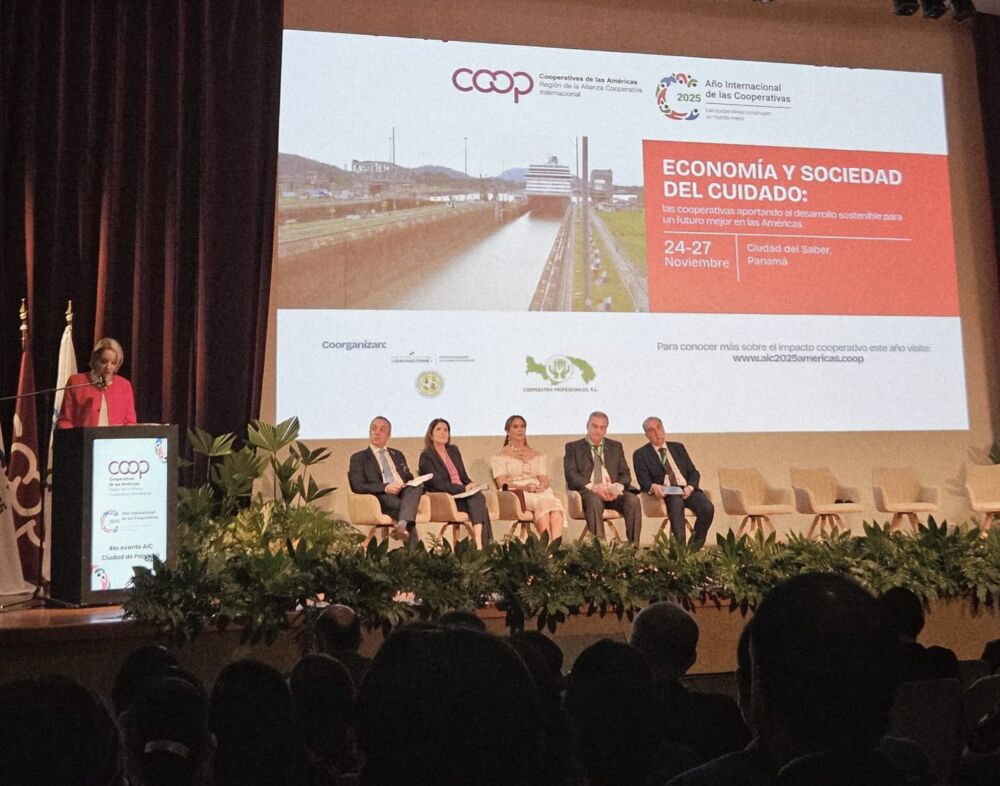
We Effect participated in the Green Economy+I Laboratory, held in Panama City from 24–27 November, as part of the closing of the International Year of Cooperatives. The event brought together the International Cooperative Alliance (ICA), ECLAC, FAO, ILO, UNDP, other UN agencies, and global networks of the social and solidarity economy, with the goal of showcasing the contributions of cooperatives to the care economy, the green transition, and sustainable development.
A Strategic Space for the Global Care Agenda and Cooperativism
One of the central topics of the event was the recent signing of the EU–CELAC Bi-regional Care Pact, which recognizes care as a right, a need, a form of work, and an opportunity to drive transformative public policies.
ECLAC presented key projections on the investments needed to close care gaps by 2035:
-
An investment equivalent to 4.7% of the regional GDP is required;
-
This would generate 31 million jobs;
-
It would contribute to reducing the gender employment gap;
-
And would increase fiscal revenue by 3.1%.
These figures position care as an economic engine, not merely a social agenda, opening opportunities for cooperative models that integrate wellbeing, employment, and sustainability.
Cooperatives: Key Actors for More Sustainable Societies
Throughout the Laboratory, the cooperative movement was recognized as a sector capable of:
-
Driving local, innovative, community-adapted solutions;
-
Connecting the green transition with social and economic wellbeing;
-
Sustaining solidarity-based, democratic, and resilient economies;
-
Accelerating the transition toward care-centered societies.
ECLAC also announced the creation of the Observatory of the Social and Solidarity Economy, in partnership with the ICA, with openness to include a dedicated chapter on care and cooperativism. This represents an opportunity for We Effect to contribute evidence from Central America.
Links to Global Agendas: Rural Women, Care, and the Green Transition
Two important global developments were confirmed during the event:
-
2025 will mark the beginning of the Decade for Building Sustainable Societies, integrating the green transition, just economies, and care systems;
-
FAO officially confirmed the International Year of Women Farmers, recognizing their role in food production, care, and climate resilience.
These milestones create opportunities to highlight women’s leadership in cooperatives, strengthen sustainable value chains, and amplify territorial experiences that connect agriculture, care systems, and cooperative governance.
We Effect’s Contribution: Cooperative Housing and Care from the Territory
Our Regional Director for Central America, Damaris Ruiz, presented We Effect’s experience in:
-
Cooperative housing (CVAM) as community infrastructure for the care economy;
-
Integrating adequate housing, climate resilience, and solidarity-based governance;
-
Linking cooperative housing with the green transition;
-
Lessons learned on women’s participation and democratic governance.
Her presentation was highlighted by the ILO and the International Cooperative Alliance, which recognized We Effect’s model as an important innovation for global agendas on care, sustainability, and the social and solidarity economy. Both institutions expressed interest in expanding collaboration to Colombia and at a global level.